



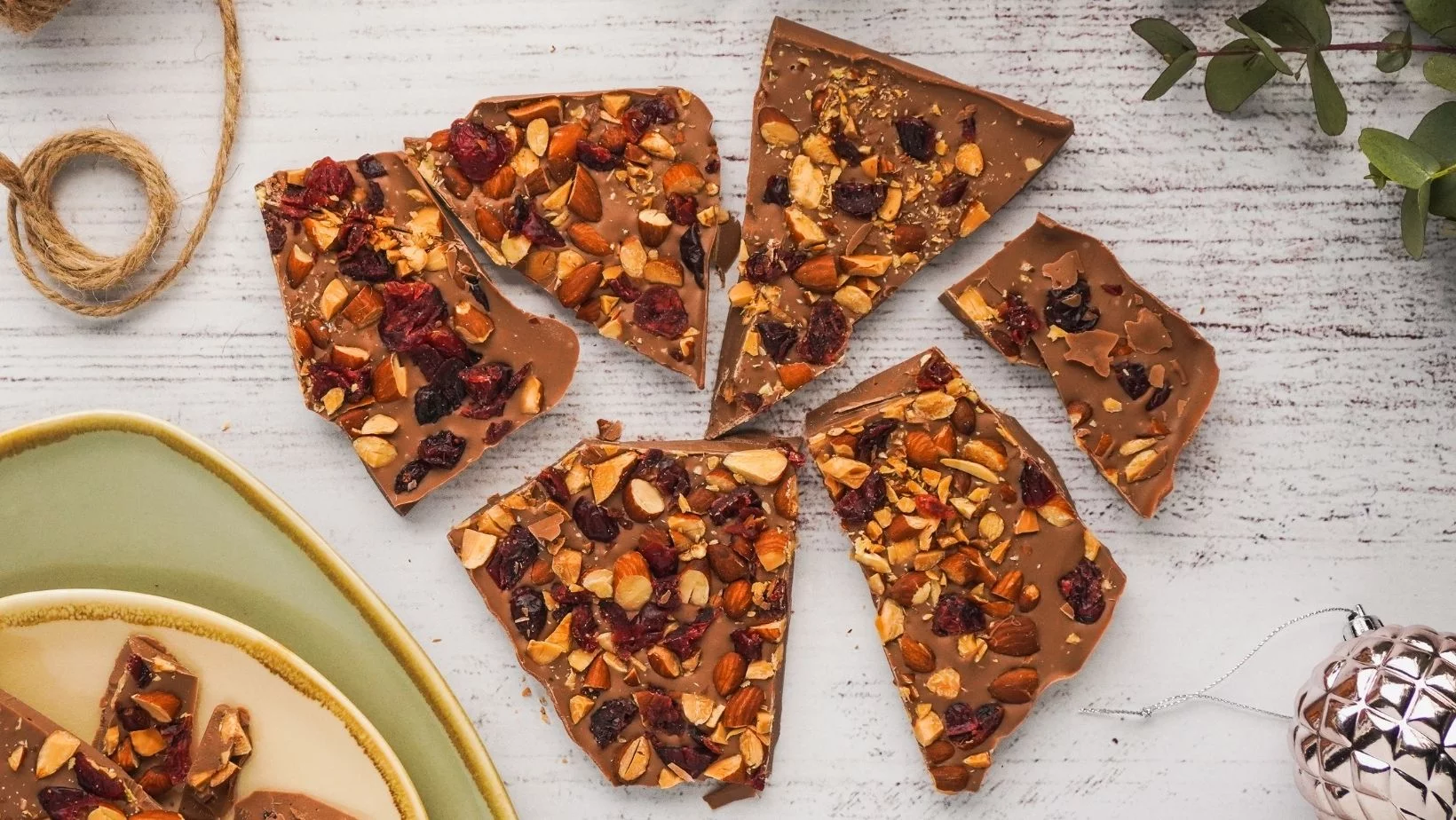
Almond & Cranberry Bark
Preparation 15 Minutes
Cook 5 MIN | CHILL: 1 HR Minutes
Serves
Method
In 160 degree oven. Toast the almonds on a rimmed baking sheet until fragrant and turning lightly golden on the edges, about 6 minutes.
Transfer the nuts to a cutting board and roughly chop them.
Place the chocolate in a large heat-proof bowl over a pot of gently simmering water. Cook until the chocolate is almost entirely melted, stirring frequently.
Cover a large, rimmed baking sheet with parchment paper. Use a silicone or rubber spatula to spread chocolate evenly over the centre area of the baking sheet—aim for about ¼″ thickness
Sprinkle the nuts evenly over the chocolate, followed by the cranberries. Lightly use your palms to press the toppings into the chocolate.
Place the pan on a flat surface in the refrigerator to set.
Once the chocolate is completely hardened, use your hands to break it into about 25 pieces. Serve immediately, or cover and store at room temperature for up to 1 week
Ingredients
400g quality chocolate
45g SUNBEAM Almonds, toasted
30g ANGAS PARK Cranberries
Recipe Collection

Aussie Ice-cream Pudding
Preheat oven to 180ºC.
- Brush a 2 litre pudding basin with vegetable oil, then line with plastic wrap, trying to keep wrap smooth without wrinkles. Place in the freezer to chill.
- In a bowl combine sultanas, raisins, cranberries, apricots, macadamias and orange liqueur. Leave to soak for 30 minutes.
- Place softened ice cream in a large bowl stir in soaked fruit. Fold in whipped cream and pour mixture into prepared pudding basin. Place in the freezer and freeze for 4 hours or overnight.
- To prepare orange cake, cream butter and sugar until light and fluffy. Beat in eggs one at a time. Stir in almond meal, orange juice and rind. Pour into a greased and paper lined 20cm cake tin and bake for 1 hour. Allow too cool in the tin, before turning out onto a board.
- To finish pudding, ease ice-cream pudding from basin and place on top of cake. Trim the cake edges if required and serve cut into thick slices.
Traditional Hot Cross Buns
Place your flour, yeast, sugar, allspice, cinnamon and salt in your mixing bowl and briefly mix until combined.
Add in your melted butter, warm milk, eggs and raisins.
Mix with your dough hook on medium speed for 5-7 minutes until a dough ball is formed and is coming away from the sides of the bowl.
Leave the dough covered with clingfilm in a warm place for approximately 1 hour or until doubles in size.
Knock the air out of the dough and roll it into a log before cutting it into 12 even pieces.
Roll each piece into a smooth ball and place into a grease proof paper linen baking tray (approx. 30cm x 20cm) in a 3 bun by 4 bun pattern.
Cover balls of dough with cling film again and let rise for approximately 40 minutes or until it has risen to about 70% of its original size.
Pre heat oven to 180 degrees after leaving it to rest.
Right before placing it into the oven make your cross mixture by mixing your flour and water until a thickish paste forms. Using a ziplock bag with the corner cut off or a piping bag, pipe your crosses down the center of each bun horizontally and then vertically.
Bake in the oven for approximately 20 minutes or until nice and golden brown.
Meanwhile, place jam and water in a bowl and microwave for approx. 30 seconds until melted and combines.
Once buns are fresh out the over, brush your glaze over each one to give them a beautiful glossy finish.
Christmas Cheesecake
Preheat oven to 180oC (160oC fan). Generously grease a 20cm round, loose-bottom (or springform) tin. Line the base with baking paper.
In the bowl of a food processor, add biscuits. Blitz to a fine crumb. Add 250g of the melted butter and blitz until just combined. Spoon the mixture into the prepared tin and use a spatula to gentle push half of the mixture up the sides of the tin. Spread remaining mixture evenly over the base (using a drinking glass can help to compact the mixture around the sides and base). Refrigerate.
In the bowl of a stand mixer fitted with a whisk attachment, combine remaining butter with sugar and whisk until combined. With the motor running, add eggs one at a time until incorporated. Scrape down the sides of the bowl and add cream cheese, quark, sour cream and vanilla, whisk until smooth. Add cornflour and mix until incorporated.
Add peel and sultanas and gently fold through the cream mixture, then spoon into the prepared base and smooth the surface.
Bake cheesecake for 10mins then reduce oven temperature to 170°C (150°C fan) and bake for a further 50 mins. Turn off the oven, leaving the door slightly open, allow cheesecake to sit in the oven for a further hour until the edges of the cheesecake feel firm when gently pressed.
Allow the cheesecake to cool completely at room temperature then remove sides of tin and transfer cheesecake to refrigerator to cool overnight.
To make the meringue decoration, place the egg whites and caster sugar in a large bowl and whip into soft peaks. Spoon the meringue on top of the cheese cake and shape with a spatula. Use kitchen blow torch to lightly crisp the outside of the meringue. Serve and enjoy!
Traditional Christmas Pudding
- Combine the fruit, brandy, rind and apple in a microwave safe bowl and mix well. Cover then microwave on 100% power for 2-3 minutes or until plumped. Allow to cool.
- Cream the butter and sugar until light and fluffy. Gradually add the egg, beating well between each addition. Fold in the sifted flour and spices, fruit mixture, breadcrumbs and almonds, mix well.
- Spoon the mixture into a greased and base paper lined 2 litre capacity pudding basin. Cover with a tight-fitting lid. Place on an upturned saucer in the base of a large saucepan or boiler. Pour boiling water into the saucepan so that is comes halfway up the sides of the basin. Cover the saucepan with a tight-fitting lid and steam for 4 hours, topping up water every 20-30 minutes or as required.
- Remove from the basin onto a serving plate, flambé with a little brandy if desired then slice and serve with custard or ice-cream.
NB: If you do not have a lid for your basin: Cover with a greased double layer of foil and baking paper, create a deep pleat in the centre for expansion. Place over the basin and secure tightly with string. Trim the cover if necessary.
If you do not intend on using the pudding immediately, keep the cover intact and store in the fridge until required. Re- steam for 1 1/2 hours when required.
Carrot & Sultana Cake
Preheat oven to 180C. Grease and line two 20cm cake tins.
In a large bowl, sift the flour, baking powder, bicarb, spices and salt. Stir to combine.
In a stand mixer, beat the eggs, sugars, oil and vanilla until smooth. Add half of the flour mix and mix on low speed until combined. Add remaining flour mix and mix on low speed again until all of the flour is incorporated. Add the pineapple and sultanas. Stir with a wooden spoon to combine.
Divide evenly between the prepared tins and bake for 40 mins or until cooked. Rotate the cakes after 20 mins. (You can test with a skewer, and the cake is ready when the skewer comes out clean.)
Cool the cakes in the pans for 10 mins, then transfer to cooling racks and leave until cooled.
Meanwhile, prepare the icing.
In a stand mixer, beat the butter on medium speed until very pale and creamy, about 4 mins. Add half of the sifted icing sugar and beat on low speed for about 1 min. Increase speed to medium to combine. Add remaining icing sugar and reduce speed to low for a further minute, then increase to medium speed for another few minutes until all of the icing sugar is combined. Add the vanilla and 1 tablespoon of the milk. Beat for 1 minute or until combined. Add extra tablespoon of milk of you would like a thinner frosting.
Divide the frosting between the centre of the cakes, reserving the remainder for the top and the sides.
Decorate with topping of choice.
Traditional Christmas Puddings
- Combine mixed fruit, raisins, brandy and cranberry sauce in a large bowl. Cover and set aside overnight or for at least 2 hours.
- Cream butter and sugar until pale and fluffy, beat in maple syrup. Add eggs one at a time, beating well between each addition. Stir butter mixture, sifted self-raising flour and spices, fresh breadcrumbs and almonds into soaked fruit, mixing well.
- Grease a 2 litre and 1 litre capacity pudding basin and a line both the bases with a double layer of baking paper. Fill mixture into the large basin to approximately 3cm from top of basin. Spoon remainder into small basin and smooth tops. Double line each of the tops of the puddings with baking paper rounds.
- Take a 60cm long piece of baking paper and 60cm piece of foil, layer and fold in half, make a 3cm pleat in the middle (this allows for any expansion of the pudding). Place sheets over large pudding and secure tightly with string. Repeat process for small pudding.
- Place wire racks onto the base of a large and a medium saucepan and fill both one third with water and bring to the boil. Carefully place puddings onto wire rack in each saucepan making sure the water level comes about halfway up each pudding basin. Cover and simmer the large pudding 6 hours and the small pudding for 4 hours. Replenish with boiling water when needed.
- Serve with custard or cream with a dash of brandy added.