



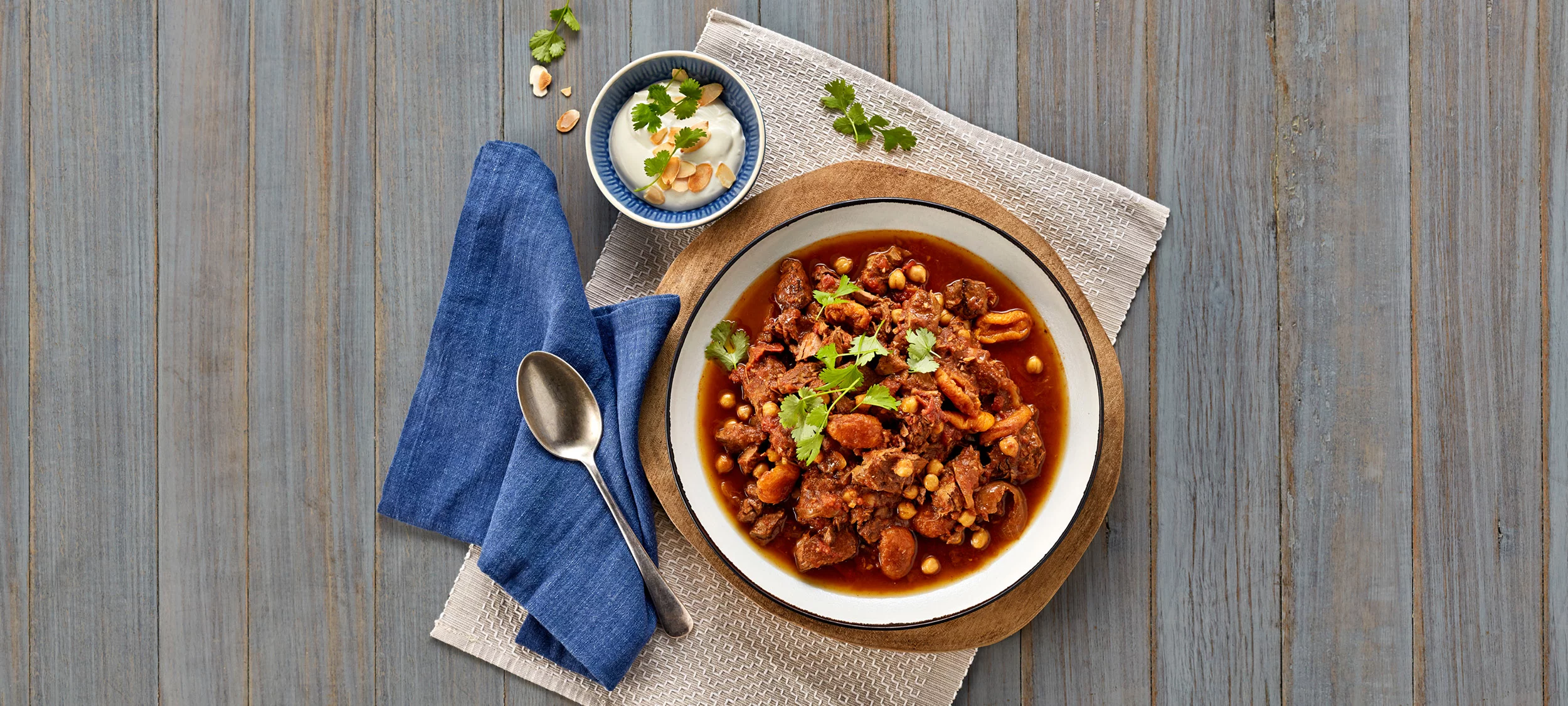
Beef & Apricot Tagine
Preparation 20 Minutes
Cook 8 hours Minutes
Serves 4-6
Method
1. Heat half of the oil in a large frying pan, add onion and garlic and cook for 3-4 minutes until tender. Add spices and cook a further minute until fragrant. Add to the pot of a slow cooker.
2. Using the remaining oil, sear beef in batches until well browned. Add to the slow cooker with the stock, tomatoes, cinnamon and orange peel. Cook on low heat for 8 hours.
3. Add the apricots and chickpeas in the last 30 minutes of cooking time. Season well. Serve beef with almonds and coriander and accompany with rice and yoghurt.
*For a faster cooking time, cook on High heat for 4 hours.
Ingredients
2 tbsp olive oil
1 onion, sliced
2 cloves garlic, crushed
2 tsp cumin
2 tsp sweet paprika
1 tsp ground coriander
1 tsp ground ginger
1kg beef (blade or rump), cut into 4cm dice
2 cups chicken stock
400g can crushed tomatoes
1 cinnamon stick
2 strips orange peel
½ cup ANGUS PARK Dried Apricot Halves
½ cup drained and rinsed chickpeas
SUNBEAM Flaked Almonds, toasted and coriander, for serving
Recipe Collection

Chocolate & Hazelnut Meringue
- Preheat oven to 140°C (120°C fan-forced). Trace 3 x 15cm diameter circles on baking paper and place onto oven trays.
- Set aside half of the hazelnuts and finely chop remaining half.
- Place egg whites in the bowl of an electric mixer and beat until firm peaks have formed. Gradually add sugar a little at a time until all has been incorporated and mixture is thick and glossy. Remove bowl from machine and gently fold in the chopped hazelnuts and cocoa with a large metal spoon, until just combined.
- Divide mixture between prepared oven trays, spreading it within each of the circles. Bake for 1 hour, then turn the oven off and allow meringues to cool in the oven.
- For the cream, whip the cream and sugar together until firm peaks form. Roughly squash half of the raspberries with a fork and fold into the cream.
- For assembly, place one meringue disc onto a serving plate, top with ⅓ of the cream. Repeat process using all meringues and finishing with cream on top. Decorate with remaining raspberries and reserved hazelnuts. Allow to sit for at least 30 minutes prior to serving.
Chocolate Fudge Cookies
- Pre-heat oven to 180°C (160°C fan-forced). Place chocolate in a microwave proof container and cook in 30 second increments until melted and smooth, whilst stirring regularly. Allow to cool.
- Place butter, sugar and vanilla in the bowl of an electric mixer and beat until pale and creamy. Add eggs one at a time, until well incorporated. Fold in melted chocolate.
- Fold in flour and almond meal. Refrigerate cookie dough, covered for at least 1 hour.
- Roll chilled dough into 48 small balls and press down lightly onto lined oven trays. Bake for 10-12 minutes. Allow to cool on tray before removing to a cooling rack to cool completely.
- For ganache, place chocolate and cream in a microwave proof bowl and cook in 15 second increments until melted and smooth, whilst stirring regularly. Allow to cool slightly before using ganache to join cookies together, to make 24.
Apricot Balls
- Place apricots, sultanas and water in a small saucepan. Bring to a gentle boil, then simmer for 2-3 minutes.
- Place cooled fruit in a food processor and pulse until smooth. Add oats and coconut. Remove to a bowl and roll teaspoonsful into balls and then roll in sesame seeds to coat. Refrigerate until required.
Notes:
Balls can also be rolled in coconut, chopped pepitas or chopped nuts.
Ricotta & Apricot Loaf with Thyme
- Pre-heat oven to 180°C (160°C fan-forced). Line the base and sides of a 10 x 20cm loaf pan.
- Combine butter, eggs and sugar in a large mixing bowl. Whisk well. Add flour and mix until just combined.
- Fold in the ricotta, apricots and thyme. Spoon into prepared pan and sprinkle the top with almonds and thyme. Bake for 45-50 minutes, or until an inserted skewer comes out clean. Allow to cool slightly before removing from the pan.
Gingerbread Decorations
-
Place butter, sugar and golden syrup in the bowl of an electric mixer. Beat until creamy. Add egg and mix until well combined.
-
Gently fold in the flour, almond meal and spices until a dough has formed. Shape into a flattened ball and refrigerate for at least 30 minutes.
-
Pre-heat oven to 180C (160C fan-forced). Roll the dough out onto a floured surface to 5mm thickness. Using star and round shaped cutters, cut shapes and transfer to lined oven trays. Using a small piping nozzle, cut a hole in the top of each shape prior to baking. Re-roll the dough offcuts until all has been used.
-
Bake for 12-14 minutes, until golden. Allow to cool on trays for 5 minutes before removing to a cooling rack to cool completely.
- Once cool, decorate the biscuits with icing and currants. Thread lengths of ribbon through the holes and tie. Decorate your Christmas tree or give as gifts.
Alternative option: Prior to baking, press flaked almonds or slivered almonds into the dough and bake. Once cooked and cool, dust with icing sugar.
Rocky Road
Grease and line the base and sides of a 20cm square baking tin.
Mix together raisins, cherries, marshmallows and pistachios. Pour 1 cup of the mixture into the base of the prepared tin.
Combine chocolate and butter in a heatproof bowl, microwave for 30 seconds, stir then microwave in 10 second bursts until melted. Allow to cool for about 5 mins before adding the remaining fruit and nut mixture. Toss to coat then pour into the prepared tin, gently flattening the surface. Refrigerate until firm (about 2 hours).
Remove from tin and slice into 4 long rows. Wrap in cellophane for Christmas gifting.